

How Secure Is a Contractor Storage Yard, Really?
How Secure Is a Contractor Storage Yard, Really?
—
August 11th, 2026
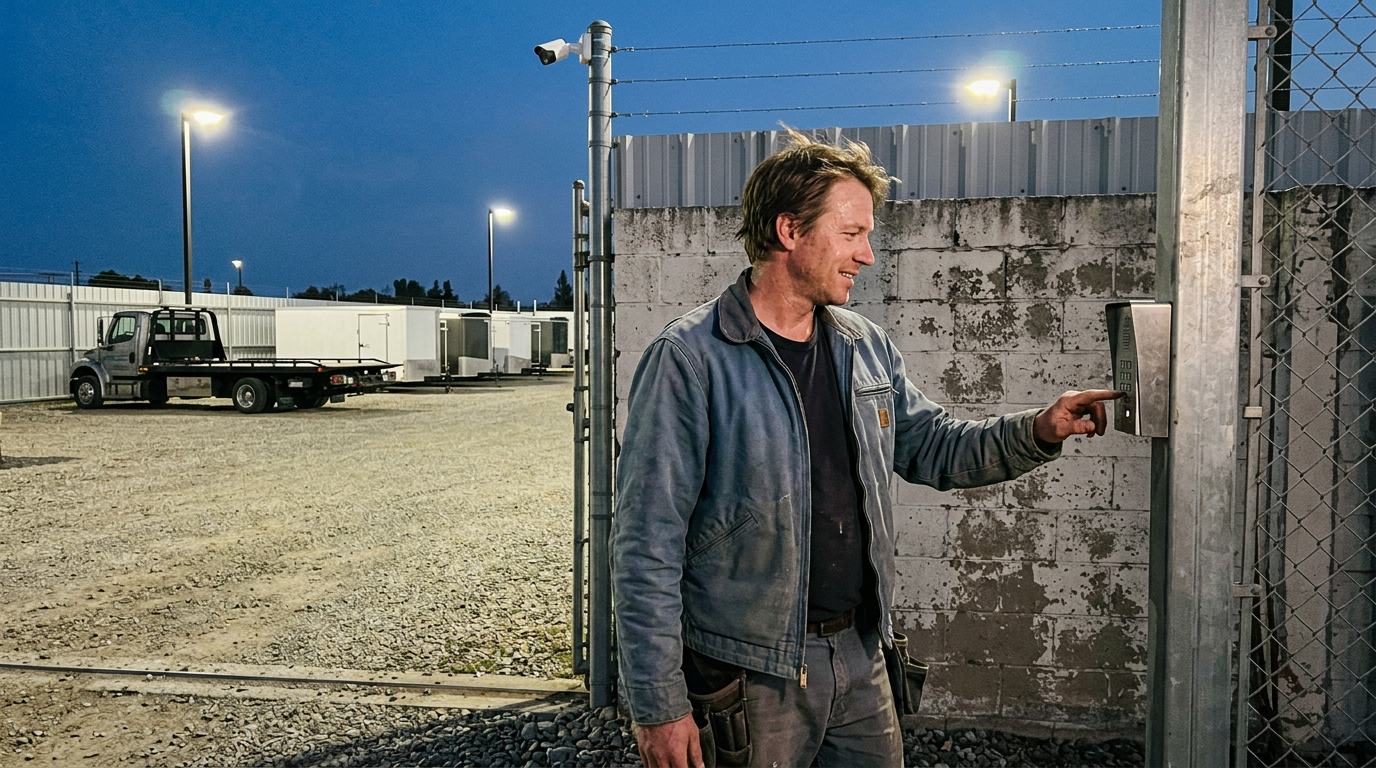
When evaluating whether a contractor storage yard is secure enough for equipment and materials, look for six specific features: individually fenced and demised yards, commercial-grade perimeter fencing, blackout screening that limits outside visibility, controlled keypad access at both entry and exit, on-site management presence during operating hours, and security cameras with adequate lighting throughout the facility. A yard that is missing any one of these is a meaningful step down in protection - not just a minor gap.
The stakes are not abstract. A roofing contractor who moved to a properly secured facility described it plainly: he had $40,000 worth of equipment stolen from an unsecured yard - no cameras, no management, no real fencing. That single theft cost more than two years of premium storage rent. Security is not a feature to negotiate away in exchange for a lower monthly rate.
What Physical Features Actually Separate a Secure Yard from an Open Lot?
The most reliable way to evaluate physical security is to treat it as a layered system rather than a single feature. Each layer addresses a different point of failure.
The first layer is perimeter control. Commercial-grade fencing - at a minimum, eight feet in height - establishes a physical boundary that deters casual intrusion. But fencing height alone is not sufficient. Blackout screening is a meaningful differentiator because it prevents opportunistic theft by eliminating line-of-sight visibility to equipment and materials stored inside the yard. A thief who cannot see what is inside has less incentive to attempt entry and less information to plan around.
The second layer is access control. Controlled keypad access at both entry and exit points means that access is logged and limited to authorized users. This matters for two reasons: it keeps unauthorized individuals out, and it creates an auditable record of who entered and when.
The third layer is the physical separation of individual yards. A facility where tenants share open common storage is categorically different from one where each tenant occupies an individually demised yard with its own fencing. Shared lots create shared risk - your exposure is not just to outsiders but to everyone else on the property.
| Security Feature | Open Lot | Shared Compound | Individually Demised Yard |
|---|---|---|---|
| Perimeter fencing | None or minimal | Facility perimeter only | Individual yard + facility perimeter |
| Blackout screening | None | Rarely | Yes (Class A standard) |
| Access control | None or padlock | Single gate | Keypad entry and exit |
| Visibility from outside | Full | Partial | Eliminated |
| Neighbor exposure | High | Moderate | None |
The takeaway: individually demised yards with blackout screening and keypad access represent a fundamentally different security tier than an open or shared lot - not an incremental improvement.
Does On-Site Management Actually Matter, or Is It Just a Selling Point?
On-site management adds a layer of accountability that unmanned facilities cannot replicate, and its presence during operating hours deters unauthorized access more effectively than cameras or fencing alone. Cameras record events; management prevents them.
The distinction is practical. A camera documents that a theft occurred. A manager who is physically present can intervene before it happens, respond to a triggered alarm in real time, and recognize when something looks wrong - a vehicle parked in an unusual location, a gate that did not close properly, an unfamiliar person on the property. That active presence changes the risk profile of the facility in a way that passive surveillance cannot.
For trade businesses storing high-value assets - HVAC equipment, towing fleet vehicles, electrical materials, masonry forms, or roofing trucks - the difference between a documented loss and a prevented one is significant. The operational disruption from stolen or damaged equipment extends well beyond the replacement cost: missed jobs, delayed crews, and emergency sourcing all carry costs that rarely show up in a simple theft claim.
On-site management also means there is a named, reachable person responsible for the facility. That accountability matters when something goes wrong, and it is something an unmanned facility structurally cannot offer.
What Should the Lighting and Camera Infrastructure Look Like?
Adequate lighting and camera coverage are the most visible indicators of how seriously a facility takes security - and the easiest to verify during a site visit.
Lighting should cover all movement areas: entry and exit points, driving lanes, and the perimeter of individual yards. Gaps in lighting create blind spots that cameras cannot fully compensate for. Brand new LED lighting throughout a facility signals that the infrastructure has been recently invested in, rather than maintained at a minimum. Older or inconsistent lighting is a sign that security has not been a priority.
Camera placement should follow the same logic: entry and exit, driving lanes, and coverage of individual yards. The question to ask during a site visit is not simply whether cameras exist, but whether their placement actually covers the areas where equipment is stored and accessed. A single camera at the front gate is not a security system - it is a gesture toward one.
Together, lighting and cameras support on-site management rather than substitute for it. A well-lit, well-monitored facility makes it easier for management to respond to anything unusual, and it makes the facility a less attractive target in the first place.
How Do You Evaluate Security When Comparing Yards in the Denver Area?
Comparing contractor storage yards in the Denver metro in 2026 requires moving past the marketing language and looking at the physical reality of each facility. The questions to ask are specific:
Are the yards individually demised, or does each tenant share open common space? Does the facility use blackout screening, or is the interior visible from the street or neighboring properties? Is access controlled by keypad at both entry and exit, or is there a single gate with a padlock? Is there on-site management during operating hours, or is the facility entirely unmanned? What does the lighting infrastructure look like, and when was it last updated?
An open or unmanaged lot with no perimeter fencing, no access control, and no on-site oversight represents the lowest tier of security and is generally not appropriate for high-value equipment, fleet vehicles, or staged materials. The cost difference between that tier and a Class A facility is real - but so is the cost of a single significant theft or the operational disruption of equipment that cannot be accessed when a crew needs it.
Aspen Industrial Outdoor Storage was built specifically to answer these questions with a yes at every point: individually demised yards, controlled keypad access, on-site management and security, and brand new LED lights and security cameras throughout the facility. For contractors evaluating storage options in south central Denver, it provides a measurable standard against which other yards can be compared. The Aspen IOS yard overview details the full facility layout and individual yard configurations for businesses ready to compare specifics.
Checklist
- Verify individual demising. Ask whether each tenant has a fully enclosed, separately fenced yard - not just a designated section of shared open space.
- Check for blackout screening. Walk or drive past the facility perimeter and confirm that equipment and materials stored inside are not visible from the street or adjacent properties.
- Test the access control system. Confirm that keypad access is required at both entry and exit, and ask whether access logs are maintained.
- Ask about on-site management hours. Find out who is physically present at the facility, when, and what their role is in responding to security incidents.
- Inspect the lighting and cameras during a site visit. Look for coverage gaps in driving lanes, yard perimeters, and entry points - not just at the front gate.
- For fleet operators, HVAC contractors, and other high-value equipment users: calculate the replacement cost of your most valuable stored asset and compare it against the annual cost difference between a Class A facility and an open lot.
FAQ
Who is responsible for security at a contractor storage yard - the tenant or the facility? Facility-level security - fencing, lighting, cameras, access control, and on-site management - is the facility's responsibility to provide and maintain. Tenants are responsible for securing their own yard gates and locking their equipment. A Class A facility like Aspen Industrial Outdoor Storage provides the infrastructure; tenants operate within it.
Which security feature matters most for preventing equipment theft at a contractor yard? No single feature is sufficient on its own, but blackout screening combined with individually demised yards addresses the root cause of most opportunistic theft: visibility. When equipment cannot be seen from outside the facility, the motivation and opportunity for casual theft are both reduced before any other layer of security is even tested.
What does "individually demised" mean, and why does it matter for security? An individually demised yard is a fully enclosed, separately fenced space assigned exclusively to one tenant. It means your yard shares no open boundary with another tenant's space. This matters because it eliminates cross-tenant exposure - your security is not dependent on how carefully the business next to you manages their access.
How do I know if a storage yard's cameras and lighting are actually adequate? Visit the facility in person, ideally at dusk or early evening. Walk the driving lanes and look for unlit areas, camera blind spots near yard perimeters, and coverage gaps at secondary entry points. A facility with brand new LED lighting and cameras positioned across the full property - not just the front entrance - is meaningfully different from one that has installed minimal equipment to meet a basic standard.
Where in the Denver metro can a contractor find a Class A secured storage yard with on-site management? Aspen Industrial Outdoor Storage operates at 2690 W Union Avenue in Englewood, in south-central Denver. The facility is within 30 minutes of the entire Denver metro and provides individually demised yards with controlled keypad access, on-site management, LED lighting, and security cameras throughout the property.
Is a secured contractor yard worth the higher cost compared to an open lot? The cost comparison depends on what you are storing. For a business with $40,000 or more in equipment, vehicles, or staged materials, a single theft event can exceed two or more years of the cost difference between a Class A facility and an open lot. The question is not whether the premium is worth it in the abstract - it is whether the replacement cost and operational disruption of a loss exceeds the incremental cost of proper security.
For contractors in the Denver metro evaluating storage options, the place to start is a direct site visit - not a website comparison. Walk the facility, test the gate, look at the lighting, and ask who is on-site and when. If you would like to schedule a visit to Aspen Industrial Outdoor Storage or have specific questions about yard configurations and availability, reach out directly at (720) 660-7955, manager@aspenios.com, or visit the facility at 2690 W Union Avenue, Englewood, CO 80110.
Categories